Watch enough horror and you begin to recognize familiar beats: here's the setup, there's the monster. Here's the ramp, there's the respite. Here's the fakeout, there's the finisher. And if you catch on to the pattern, it can become familiar: you time your breathing, you time your flinching and have an enjoyable, if predictable experience.
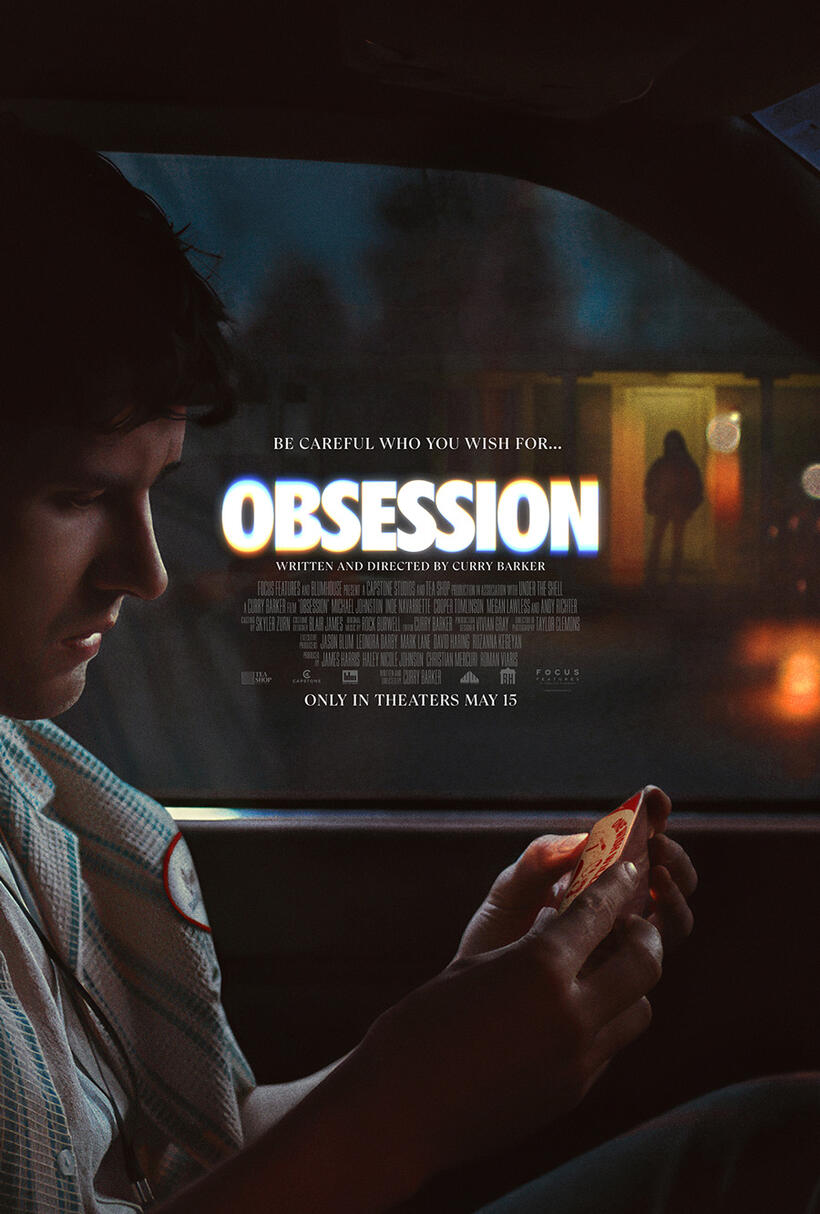
It would be a fair guess to assume that Obsession, a film about a man's desire and fantasy for a his uninterested friend would enjoy marching to this.
Instead, Obsession plays on the half-beats. The camera doesn't respect familiar paths, motion speeds up and down to create distortion. It's almost as if the ratios for the recipe have been altered, and the end result feels wrong.
This in and of itself isn't uncommon in horror. From The History and Psychology of Spooky Music and Sound Design in Film:
Clashing ideas, musical or otherwise, have a variety of uses. In horror, clashing musical notes just sounds wrong. [..] The infamous ‘tri-tone’ has been referred to as The Devil’s Interval since the late middle ages. Humans adore harmony, we latch onto notes which combine with simple mathematical ratios between their frequencies. Two notes an octave apart are at a perfect 2:1 ratio, and this relationship is so perfect to our ears that we give both notes the same (only an octave apart). The tri-tones on the other hand have an unbearable ratio of 45:32 or 64:45 depending on tuning. Oddly enough tri-tones are often used in sirens and alarms for the way they grab our attention.
Curry Barker uses these devices to tell a story of a relationship that feels wrong as a viewer. And he does so with a sense of economy: the limerence stage doesn't get more than a few seconds of montage, enmeshment is physically painful to witness, and the characters swing moods wildly, trying to match each other's off-keyness.
Even more interesting though, is the kind of story Obsession tries to tell: it's simple enough on the tin: the horror of consent and tropes of romantically crazy women is well tuned for horror. Here too, Curry Barker chooses a different beat, and what begins as a misogynistic trope quickly becomes a surgical answer to the question of what happens when patriarchy's power fantasy is realized. There's also an absurdist streak to the film's canon that's entertaining without diffusing tension.
For a film about obsession, there's no love in sight here. The villain is a nice guy, one who gets to deny culpability as he continues to enjoy the benefits of exploitation and coercion. Portraying a single character at different times to be sympathetic, manipulative, or just a bystander is another nod to the work done with a narrow script. Inde Navarrette's portrayal of Nikki is truly special: she conveys captivity, terror, and monstrosity and is given excellent material to work with. She too portrays a multitude of characters and sets the major beats of the film. She's effortlessly talented and raises this film in many ways.
Obsession is a great watch - go in with your defenses down, it's worth it. Not since Zach Cregger's Barbarian have I been so excited for a debuting director (This is his first feature film, but he has an excellent short film catalogue on YouTube). The cinematography is spacious, but uncomfortably too much - drawing the eye into negative spaces and bracing the mind for impact.
Watch enough horror and you begin to recognize familiar beats: here's the setup, there's the monster. Here's the ramp, there's the respite. Here's the fakeout, there's the finisher. And if you catch on to the pattern, it can become familiar: you time your breathing, you time your flinching and have an enjoyable, if predictable experience.
It would be a fair guess to assume that Obsession, a film about a man's desire and fantasy for a his uninterested friend would enjoy marching to this.
Instead, Obsession plays on the half-beats. The camera doesn't respect familiar paths, motion speeds up and down to create distortion. It's almost as if the ratios for the recipe have been altered, and the end result feels wrong.
This in and of itself isn't uncommon in horror. From The History and Psychology of Spooky Music and Sound Design in Film:
Clashing ideas, musical or otherwise, have a variety of uses. In horror, clashing musical notes just sounds wrong. [..] The infamous ‘tri-tone’ has been referred to as The Devil’s Interval since the late middle ages. Humans adore harmony, we latch onto notes which combine with simple mathematical ratios between their frequencies. Two notes an octave apart are at a perfect 2:1 ratio, and this relationship is so perfect to our ears that we give both notes the same (only an octave apart). The tri-tones on the other hand have an unbearable ratio of 45:32 or 64:45 depending on tuning. Oddly enough tri-tones are often used in sirens and alarms for the way they grab our attention.
Curry Barker uses these devices to tell a story of a relationship that feels wrong as a viewer. And he does so with a sense of economy: the limerence stage doesn't get more than a few seconds of montage, enmeshment is physically painful to witness, and the characters swing moods wildly, trying to match each other's off-keyness.
Even more interesting though, is the kind of story Obsession tries to tell: it's simple enough on the tin: the horror of consent and tropes of romantically crazy women is well tuned for horror. Here too, Curry Barker chooses a different beat, and what begins as a misogynistic trope quickly becomes a surgical answer to the question of what happens when patriarchy's power fantasy is realized. There's also an absurdist streak to the film's canon that's entertaining without diffusing tension.
For a film about obsession, there's no love in sight here. The villain is a nice guy, one who gets to deny culpability as he continues to enjoy the benefits of exploitation and coercion. Portraying a single character at different times to be sympathetic, manipulative, or just a bystander is another nod to the work done with a narrow script. Inde Navarrette's portrayal of Nikki is truly special: she conveys captivity, terror, and monstrosity and is given excellent material to work with. She too portrays a multitude of characters and sets the major beats of the film. She's effortlessly talented and raises this film in many ways.
Obsession is a great watch - go in with your defenses down, it's worth it. Not since Zach Cregger's Barbarian have I been so excited for a debuting director (This is his first feature film, but he has an excellent short film catalogue on YouTube). The cinematography is spacious, but uncomfortably too much - drawing the eye into negative spaces and bracing the mind for impact.